Optoelectronic Hybird Integration | E-mail:sales1@cqwiseworld.com
Views: 0 Author: Site Editor Publish Time: 2026-08-01 Origin: Site
Facing fiber exhaustion is a growing nightmare for modern data centers. Network operators must scale capacity rapidly without laying new, expensive physical fiber. Wavelength Division Multiplexing (WDM) solves this capacity crunch brilliantly. You can multiply your existing infrastructure's throughput simply by upgrading terminal equipment. However, choosing the right infrastructure remains critical to balancing initial capital expenditures and future network scalability.
At the heart of this technical decision sits the optical transmitter. This single component converts raw electrical data into precise optical wavelengths. It dictates the precision, maximum transmission distance, and total channel capacity of your entire network. If you choose the wrong transmitter type, you risk severe bottlenecks as bandwidth demands increase.
We will provide a transparent, specification-driven comparison between CWDM and DWDM transmitters. You will learn the core mechanical differences, deployment trade-offs, and distinct scaling limits. This guide empowers you to navigate complex procurement cycles confidently and map out robust network architecture decisions.
CWDM transmitters offer a cost-effective, uncooled solution for shorter-distance (up to 80km) and lower-capacity needs (up to 18 channels).
DWDM transmitters utilize precision-cooled lasers to achieve narrow channel spacing, enabling high-density, long-haul transmission (96+ channels).
Initial deployment costs are significantly lower for CWDM, but DWDM provides superior long-term ROI for high-growth or carrier-grade networks.
Form-factor innovations, such as the Mini DM optical transmitter module, are bridging the gap for space-constrained deployments.
An optical transmitter serves a foundational purpose in any fiber network. It converts electrical data signals into multiplexed optical light streams. The transmitter beams these colored light streams down a fiber optic cable. The receiving end then catches and decodes these streams back into digital data. The core difference between various WDM technologies lies in how the transmitter generates and manages these distinct light channels.
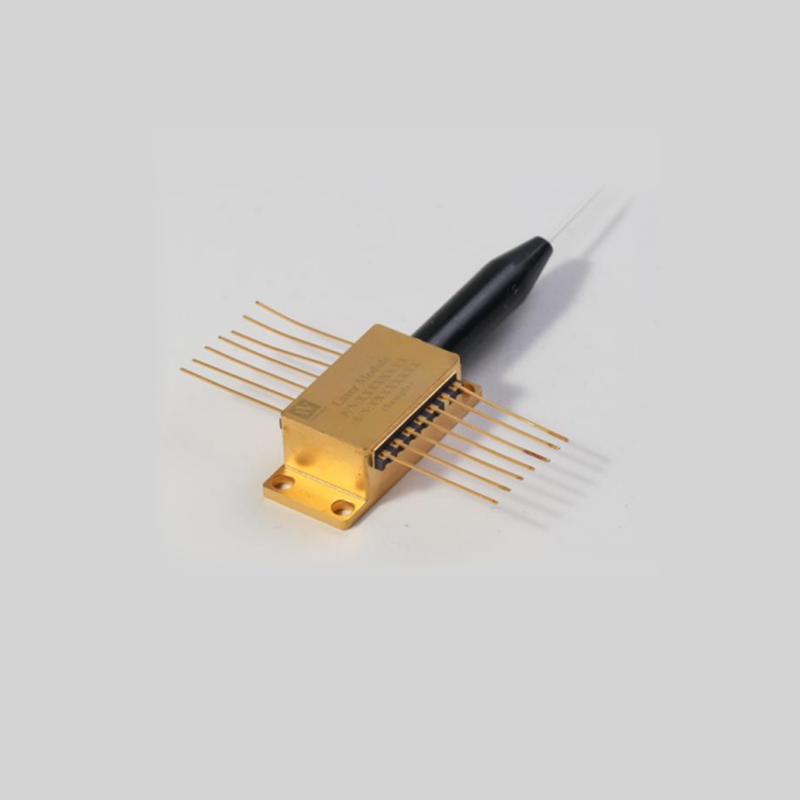
Coarse Wavelength Division Multiplexing (CWDM) relies on simplicity and ruggedness. A CWDM DFB Laser Optical Transmitter utilizes uncooled Distributed Feedback (DFB) lasers. Because these lasers lack active cooling mechanisms, their emitted wavelengths drift slightly as ambient temperatures fluctuate.
Engineers design CWDM systems to tolerate wider temperature fluctuations gracefully. The industry standard assigns a massive 20 nanometers of space between each channel. This wide berth ensures channels do not overlap even if the laser drifts during extreme heat or cold. The uncooled design consumes significantly less power. However, it is inherently limited in spectral efficiency. You simply cannot pack many channels into a single fiber strand using such wide spacing.
Common characteristics include:
Broad operating temperature ranges without external climate control.
Lower electrical power draw per port.
Simplified internal component architecture.
Passive multiplexing compatibility.
Dense Wavelength Division Multiplexing (DWDM) takes a vastly different engineering approach. A DWDM DFB Laser Optical Transmitter requires precisely controlled, cooled DFB lasers. Manufacturers integrate Thermo-Electric Coolers (TEC) directly into the transmitter package. The TEC monitors the laser diode constantly and adjusts internal temperatures to stabilize the output.
This temperature management maintains absolute wavelength stability. Locked wavelengths prevent adjacent channel crosstalk. Consequently, network engineers can place DWDM channels incredibly close together—often just 0.8 nanometers apart. This narrow spacing enables high-density data transport. The trade-off involves higher power consumption and greater complexity at the component level. The active cooling demands more electricity and generates its own secondary heat inside the equipment rack.
Key DWDM attributes include:
Stringent thermal regulation via integrated TEC.
High spectral efficiency.
Extreme wavelength precision.
Compatibility with specialized optical amplifiers.
Understanding the raw specifications is vital for network architects. We compiled the primary operational differences between CWDM and DWDM into a direct comparison. This structure allows you to evaluate exactly where each technology excels and where it falls short.
Evaluation Dimension | CWDM Transmitters | DWDM Transmitters |
|---|---|---|
Channel Spacing | 20 nm (Wide spacing) | 0.8 nm or 0.4 nm (Narrow spacing) |
Channel Capacity | Up to 18 channels | 40, 80, or 96+ channels in the C-band |
Transmission Distance | Capped at ~80km | Thousands of kilometers (via EDFA) |
Modulation & Speed | Practical limits around 10G/25G per channel | Superior handling of 100G/400G+ coherent optics |
Laser Architecture | Uncooled DFB | Cooled DFB (TEC integrated) |
Channel Spacing and Capacity
The 20 nm channel spacing in CWDM directly restricts its total channel count. Standard CWDM networks support up to 18 channels. Conversely, DWDM operates tightly within the C-band spectrum. Spacing channels at 0.8 nm (100 GHz) or 0.4 nm (50 GHz) allows DWDM to push 40, 80, or even 96+ channels over a single fiber pair. This capacity difference is staggering for high-growth networks.
Transmission Distance limits
CWDM effectively maxes out around 80 kilometers. It utilizes a wide spectrum of wavelengths. Many of these wavelengths experience high attenuation in standard silica glass. Furthermore, CWDM wavelengths do not align properly with Erbium-Doped Fiber Amplifiers (EDFA). DWDM wavelengths sit perfectly within the EDFA operating window. You can boost DWDM signals repeatedly, pushing them across thousands of kilometers.
Modulation and Speed
Modern networks demand high-speed protocols. CWDM handles 10G and 25G Ethernet traffic efficiently. However, pushing beyond 25G per channel on CWDM introduces severe signal dispersion issues. DWDM supports advanced coherent optics. These sophisticated modulation formats allow DWDM transmitters to handle 100G, 400G, and even 800G wavelengths effortlessly.
Technical specifications matter, but commercial outcomes drive actual procurement decisions. Network operators must translate wavelengths and laser types into tangible business logic. Each technology serves specific financial and operational scenarios uniquely.
CWDM shines in environments requiring quick, budget-conscious capacity upgrades over short distances. It is typically ideal for Enterprise Local Area Networks (LAN), short-haul Data Center Interconnects (DCI), and Metro access networks.
The commercial advantage centers entirely on upfront savings and simplicity. You experience drastically lower transceiver costs because manufacturers skip the expensive cooling hardware. Many CWDM deployments utilize completely passive multiplexers and demultiplexers. These passive units require zero electrical power. They simply plug into the fiber and split the light mechanically. This results in remarkably lower ongoing operational power costs. If your facility only needs to link two buildings across a city, CWDM provides an unbeatable, lean solution.
DWDM handles the heavy lifting for massive infrastructure grids. You require DWDM for carrier networks, long-haul regional transport, and hyper-scale DCI applications. The scale of these networks renders CWDM entirely inadequate.
The commercial advantage requires a longer-term perspective. DWDM incurs a substantially higher initial capital expenditure. The transmitters cost more, and the active multiplexers require power and management. However, DWDM delivers exponentially lower cost-per-bit as your bandwidth demand scales. Adding your 40th or 80th channel to an existing DWDM chassis is marginal in cost. Deploying a robust DWDM backbone prevents painful, expensive "rip-and-replace" upgrades in the future. You build the highway once, and you simply add more lanes later through modular upgrades.
Network realities often dictate technology choices as much as bandwidth needs do. Equipment footprints and environmental realities pose massive hurdles for field engineers.
Traditional DWDM gear occupies significant physical space. Standard chassis systems take up multiple rack units in a data center. They are bulky and power-intensive. This poses a massive barrier for edge deployments. Telecommunication companies increasingly push computing power to the network edge. Street cabinets, cell towers, and remote enterprise closets simply lack the physical space for legacy DWDM hardware.
Hardware manufacturers recognize this edge constraint. Form-factor innovations are bridging the gap for space-constrained deployments. Engineers now utilize a Mini DM Optical Transmitter Module to deliver high-capacity bandwidth in impossibly tight spaces. These miniaturized packages deliver robust performance without the traditional footprint.
Similarly, Compact CWDM (CCWDM) offers a miniaturized alternative to standard CWDM cassettes. CCWDM utilizes free-space optics technology to shrink the multiplexing hardware. These compact solutions fit easily into crowded street enclosures. They provide legitimate answers for expanding 5G front-haul networks where space remains at an absolute premium.
You cannot condense high-performance optics without facing physics. Miniaturized high-density optical modules present notable thermal management considerations. Transmitters generate heat. Tightly packed modules concentrate this heat into very small areas. Edge environments often lack dedicated air conditioning. Network designers must plan for adequate passive airflow or localized heatsinking. Ignoring thermal density in compact module deployments leads to premature hardware failure and network outages.
Choosing between CWDM and DWDM does not need to be a guessing game. We developed a pragmatic checklist for technology buyers. Answering these four questions provides a clear shortlisting logic for your next deployment.
Current vs. Future Fiber Capacity: Are you currently sitting at 50% fiber capacity or 90%? Look at your three-year growth projections. If you are already at 90% capacity, you must default to DWDM. CWDM's 18-channel limit will bottleneck your growth too quickly.
Distance Requirements: Does any single link in your proposed network exceed 80 kilometers? If the answer is yes, CWDM is immediately disqualified. You cannot amplify CWDM signals effectively. You require DWDM and EDFA amplifiers to push signals across long distances.
Data Rate Roadmap: Are you planning a transition to 100G, 400G, or even 800G wavelengths? CWDM handles 10G and 25G reliably. Pushing high-speed coherent optics requires the precision and dispersion management inherent to DWDM systems.
Environmental Reality: Do your network edge locations have the active cooling capacity required for DWDM hardware? If your deployment involves unventilated street cabinets baking in the summer sun, you likely need environmentally hardened CWDM equipment that tolerates massive temperature swings.
Optical transmitters form the beating heart of modern fiber networks. CWDM transmitters provide rugged, uncooled reliability. They remain the practical, budget-conscious choice for short-haul capacity bumps. If you need to connect local data centers efficiently, CWDM delivers excellent results.
Conversely, DWDM transmitters represent the necessary investment for long-term, high-density scaling. Their cooled laser architecture locks wavelengths tightly, unlocking massive channel capacities. While the initial investment feels heavy, DWDM future-proofs your infrastructure against skyrocketing bandwidth demands.
Your next step requires data collection. We strongly encourage you to audit your current fiber utilization. Map out your physical distances and projected traffic growth over the next five years. Finally, consult with an optical networking engineer. A professional assessment will help you map a deployment strategy matching your specific technical requirements and financial constraints.
A: Yes. Network engineers achieve this through hybrid WDM setups. You can multiplex specific DWDM channels over existing CWDM networks. Typically, DWDM channels are layered over the 1530nm and 1550nm CWDM wavelengths. This allows you to expand a legacy CWDM network's capacity without abandoning the original hardware investment.
A: The price difference stems directly from component complexity. DWDM transmitters require precision cooled lasers. Manufacturers must integrate Thermo-Electric Coolers (TEC) to stabilize the laser temperature. Furthermore, DWDM systems require advanced dispersion compensation and tighter manufacturing tolerances to prevent channel crosstalk. These premium components drive up the manufacturing cost.
A: No. CWDM generally does not support Erbium-Doped Fiber Amplifiers (EDFA) due to severe wavelength mismatches. Its channels sit outside the optimal amplification window. DWDM, however, relies heavily on EDFA units. These amplifiers boost DWDM signals natively, allowing the light to travel thousands of kilometers without data loss.