Optoelectronic Hybird Integration | E-mail:sales1@cqwiseworld.com
Views: 0 Author: Site Editor Publish Time: 2026-08-31 Origin: Site
Modern network infrastructures face immense pressure every day. Engineers must scale data capacity aggressively to meet skyrocketing demands. Yet, they struggle against strict infrastructure footprints and rigid power limitations. Solving this dilemma requires highly careful hardware selection.
Evaluating an Optical Transmitter is never a simple commodity purchase. Instead, it represents a strategic balancing act. You must constantly weigh modulation capabilities against signal integrity. This becomes critical when deciding between NRZ and PAM4 formats. Furthermore, your long-term network scalability hangs heavily on these exact decisions.
This article provides network engineers and system integrators with a reliable, evidence-based framework. We will help you evaluate optical specifications clearly. You will learn how to map component metrics directly against real-world deployment constraints. We aim to equip you with actionable insights to optimize your infrastructure architecture.
Transmitter bandwidth is strictly governed by the interplay between the laser source, modulation technique, and optical channel limitations (dispersion/attenuation).
Direct modulation offers cost and space efficiency, while external modulation is mandatory for long-haul, high-bitrate environments to mitigate chirp.
Form-factor innovations, such as mini external modulation and mini DM modules, are shifting the traditional cost-to-performance ratios in edge and data center deployments.
Verifying performance requires rigorous characterization, moving beyond nominal bitrates to analyzing Bit Error Rate (BER) and eye-diagram metrics under protocol-specific constraints.
Data transmission relies on understanding fundamental physical properties. We must examine the exact relationship between signal baud rate and required optical bandwidth. According to Nyquist principles, your analog bandwidth must sufficiently support the digital bitrate. A 100 Gbps signal does not simply map to a 100 GHz channel. We must account for encoding overhead and spectral efficiency. Engineers frequently misjudge this precise correlation. They assume linear scaling where absolutely none exists. You must calculate your theoretical limits before purchasing hardware.
Component choices severely dictate your frequency ceiling. The internal laser diode acts as the fundamental engine of your system. Distributed Feedback (DFB) lasers support longer transmission distances. They emit highly stable single-mode light. Conversely, Vertical-Cavity Surface-Emitting Lasers (VCSEL) handle short-reach data centers. They offer excellent cost efficiency for local server clusters. Driver circuitry further limits how fast these lasers can toggle. You cannot exceed the physical switching limits of your underlying silicon. Understanding these physical bottlenecks prevents costly design errors.
Wavelength selection strictly governs achievable transmission speeds. We primarily utilize the 1310nm and 1550nm optical windows. The 1310nm window minimizes chromatic dispersion naturally. It serves remarkably well for medium distances across campus networks. The 1550nm window offers the absolute lowest inherent fiber attenuation available. Engineers reserve 1550nm for complex long-haul transport. However, it requires careful dispersion compensation techniques. Pulses spread out over long distances at this wavelength. You must deploy specialized compensation modules or digital signal processors. You must perfectly match your wavelength to your physical fiber run.
Lasers generate data pulses using two primary operational methods. Direct modulation represents the most straightforward approach. Lasers turn on and off by directly varying the drive current. Unfortunately, this sudden current shift causes severe optical chirp. Chirp drastically broadens the optical signal spectrum. Broadened signals degrade rapidly over long fibers at higher speeds. Dispersion tears the signal apart.
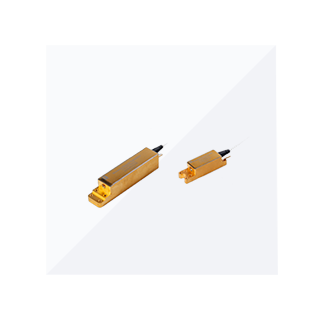
Still, direct modulation excels in specific deployment scenarios. It remains highly cost-effective and remarkably space-efficient. For cost-sensitive, short-to-medium reach applications, high density remains the absolute priority. Enterprise LANs and FTTH networks benefit greatly here. In these specific cases, deploying a Mini DM Optical Transmitter Module provides an optimized solution. It balances density requirements and physical footprint constraints flawlessly. We see immense practical value in leveraging these modules at the network edge. They deliver reliable throughput without over-engineering the link.
High-fidelity transport demands entirely different optical physics. You must physically isolate the laser source from RF signal variations. Mach-Zehnder modulators (MZMs) achieve this necessary isolation perfectly. The laser emits a steady, continuous optical wave. The MZM then shapes the light externally. Materials like Lithium Niobate manipulate the phase of the light. This completely eliminates damaging chirp from the equation.
Long-haul networks and DWDM systems require pristine signal integrity constantly. They demand superior dispersion tolerance and wide-open eye diagrams. A Mini External Modulation Optical Transmitter Module serves as the definitive standard for these rigorous environments. It delivers premium performance while maintaining a surprisingly compact footprint. You ensure signal survival across thousands of kilometers. The operational stability heavily justifies the hardware investment.
Bandwidth requirements shift drastically based on your chosen signaling standards. Non-Return-to-Zero (NRZ) uses two simple voltage levels to represent data. Pulse Amplitude Modulation 4-level (PAM4) utilizes four distinct amplitude levels. PAM4 effectively doubles your data rate within the exact same bandwidth footprint. It transmits two bits per symbol instead of one.
However, this extreme density comes at a steep technical cost. The visual eyes in a PAM4 diagram are significantly smaller. They require vastly higher Signal-to-Noise Ratio (SNR) tolerances to function. You cannot simply upgrade to PAM4 without upgrading your surrounding infrastructure. The demand for higher linearity is absolute. Forward Error Correction (FEC) becomes mandatory to fix inevitable bit errors. You must account for this extra processing latency.
Advanced architectures often struggle with signal degradation long before reaching the receiver. You must carefully assess your amplification strategy. Evaluate exactly when to integrate a Broadband Pulse Signal Amplifier Optical Transmitter into your architecture. This specialized hardware focuses intently on preserving high-speed transient signals. It boosts the signal without adding excessive spontaneous emission noise.
We frequently see this necessity in highly specialized scenarios. Distributed sensing systems rely heavily on transient preservation to detect anomalies. Specialized test environments require uncompromised signal fidelity for accurate measurements. Extending reach before receiver amplification also demands these robust tools. You must deploy them strategically to prevent noise accumulation. Placing them correctly ensures maximum link budget efficiency.
Datasheet claims often reflect highly idealized laboratory conditions. Buyers must look deeper to ensure long-term reliability. You need test metrics indicating real-world stability under operational stress. Let us break down the essential evaluation criteria.
Extinction Ratio (ER): This measures how effectively the hardware distinguishes between 1s and 0s. A higher ER means a stronger, clearer signal. It directly improves receiver sensitivity limits.
Relative Intensity Noise (RIN): Laser fluctuations constantly generate background noise. Spontaneous emission causes these minute power variations. RIN quantifies this specific impact on overall system error rates.
Jitter and Eye Mask Margins: Timing errors completely destroy fast data streams. Generous eye mask margins ensure compliance with strict telecom standards. They provide a buffer against inevitable signal degradation.
Implementation risks extend far beyond basic optical metrics. Many engineers tragically underestimate thermal management. Excessive heat directly degrades laser wavelength stability. It pushes the laser off its designated DWDM grid. It severely shortens the Mean Time Between Failures (MTBF). You must secure robust cooling mechanisms across your chassis. Overheating remains a leading cause of premature module death. Always design for maximum thermal loads.
Performance Metric Standards Breakdown
Metric Category | Measurement Focus | Target Benchmark | Real-World Impact |
|---|---|---|---|
Extinction Ratio | Signal amplitude distinction | > 4.5 dB (varies heavily by protocol) | Improves base receiver sensitivity |
RIN | Inherent laser noise levels | < -130 dB/Hz | Reduces spontaneous bit error rates |
Jitter Tolerance | Signal timing stability | Strict compliance with IEEE 802.3 | Prevents catastrophic packet loss |
Wavelength Stability | Grid alignment accuracy | ± 20 picometers drift margin | Prevents cross-channel interference |
We must strictly evaluate the operational reality of deploying new hardware. High-density mini modules offer massive space savings over standard configurations. They allow you to populate faceplates much more aggressively. However, you must meticulously verify integration practicalities. Ensure strict physical compatibility with your existing rack chassis. Test them alongside current transceivers and network management software platforms.
A smaller module often heavily restricts internal device airflow. You must model your rack thermodynamics carefully. High-density deployments generate massive localized heat pockets. You must ensure your fans can clear this thermal load. Operational reality often dictates using slightly less density to maintain cooling.
Vendor validation remains a hyper-critical procurement phase. Do not rely solely on optimal-condition marketing specifications. They rarely reflect your actual hostile deployment environment. Always demand comprehensive characterization data from your suppliers. We strongly recommend following a strict validation sequence.
Demand Bit Error Rate (BER) test results over highly specific distances.
Request extreme thermal stress test documentation spanning 48 hours.
Verify third-party interoperability certifications thoroughly.
Review long-term MTBF data collected under heavy operational loads.
Inspect eye diagrams captured at maximum rated temperatures.
Common mistakes during procurement often stem from ignoring edge cases. Vendors might promise flawless PAM4 execution on paper. Yet, their hardware might fail when rack temperatures rise unexpectedly. You must demand absolute proof of sustained performance under severe duress.
Choosing the proper hardware requires analyzing multiple interconnected technical variables.
The ideal hardware choice depends entirely on exact distance requirements and acceptable error margins.
Modulation strategies heavily dictate signal survival rates over long distances.
Proper thermal management actively prevents premature component degradation.
Rigorous vendor validation directly separates reliable hardware from marketing hype.
Understanding NRZ versus PAM4 complexities ensures successful bandwidth scaling.
Start your upgrade process with a highly thorough network audit. Define your exact channel loss budgets meticulously. You must measure current dispersion limits across all fiber runs. Finalize your specific signaling protocols before shortlisting modules. Engage vendors only after mapping these constraints precisely. This analytical approach guarantees a resilient, future-proof network infrastructure.
A: Bandwidth refers to the analog signal capacity of a channel, measured in Hertz (Hz). It defines the physical frequency range a medium can support. Bitrate represents the digital data throughput, measured in bits per second (bps). Advanced modulation formats like PAM4 allow higher bitrates to transmit over limited bandwidth channels. You must align both metrics carefully during network design.
A: You should upgrade when network distances exceed 40km or when deploying high-capacity DWDM systems. At these thresholds, direct modulation causes optical chirp, leading to critical signal failure. External modulation isolates the laser entirely. This eliminates chirp and ensures pristine signal integrity across long-haul distances. It remains mandatory for complex transport layers.
A: PAM4 signaling doubles data throughput by using four distinct amplitude levels instead of two. This drastically reduces the spacing between signal states. Consequently, transmitters must deliver significantly higher linearity and superior noise management. Strict Signal-to-Noise Ratio (SNR) tolerances become mandatory. You must also implement Forward Error Correction (FEC) to prevent elevated error rates.